

SILJ is often seen as a simple way to gain exposure to silver. Junior silver miners, higher beta, more upside when silver moves. That sounds logical.
In reality, it works differently.
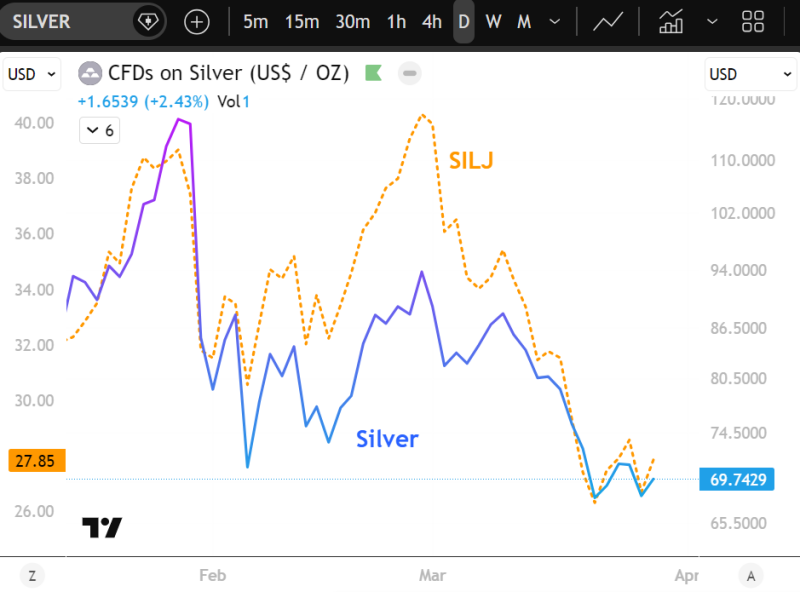
SILJ does not track silver. It amplifies moves, sometimes lags them, and in certain phases barely follows at all. That makes it something very different from passive exposure.
Why SILJ can lag even when silver rises
The assumption is straightforward. If silver goes up, miners should go up more. But that relationship is less direct than it seems.
Junior miners deal with rising costs. Energy, labor, transport. In periods where commodities move higher, these costs often rise alongside the silver price. Margins do not automatically expand.
Financing is another factor. Many junior miners are not consistently profitable. They rely on external capital to operate and grow. That means dilution is always a risk. Even in a rising silver environment, shareholder returns can lag.
There is also jurisdictional risk. A large number of junior miners operate in regions where political decisions, taxation, or regulation can shift quickly. That adds another layer of uncertainty that has nothing to do with silver itself.
This is why silver can move higher while SILJ struggles to keep up. The underlying businesses matter.
Reuters has repeatedly highlighted how cost inflation and financing conditions impact mining companies, especially smaller operators. The metal price is only one part of the equation.
The real driver is leverage
If SILJ does not simply track silver, what does it actually represent.
Leverage.
Not just financial leverage, but operational and sentiment leverage. Junior miners sit at the edge of the market. Small changes in price, expectations, or liquidity can lead to outsized moves.
When silver breaks out and margins begin to expand, the effect on juniors is exponential. Projects that were marginal suddenly become viable. Narratives shift. Capital flows in.
At the same time, the downside works just as fast. When liquidity tightens or uncertainty rises, juniors are often the first to get sold. They are not defensive assets.
This is why SILJ behaves more like a volatility amplifier than a tracking instrument.
Timing matters more than direction
One of the most overlooked aspects of junior miners is timing.
They rarely lead a move. In the early phase of a silver rally, capital tends to flow into the metal itself or into larger, more established producers. Juniors often lag during this phase.
Only later, when confidence builds and investors start reaching for higher returns, does capital rotate into smaller names. That is when SILJ can move aggressively.
This pattern has been visible across multiple cycles. Larger producers move first. Juniors follow later, often in sharp bursts.
According to coverage from Reuters and analysis across previous commodity cycles, this rotation dynamic is consistent. Early caution, followed by late-stage speculation.
Understanding this sequence matters more than simply being bullish on silver.
This is not a passive bet
SILJ is often treated as a leveraged version of silver.
It is not.
It is a mix of operational risk, financing pressure, geopolitical exposure, and market sentiment, all layered on top of the silver price.
That is why it can outperform dramatically in certain phases, and disappoint in others.
SILJ is not about predicting silver.
It is about understanding when leverage, liquidity, and timing align.

Add comment
Comments