

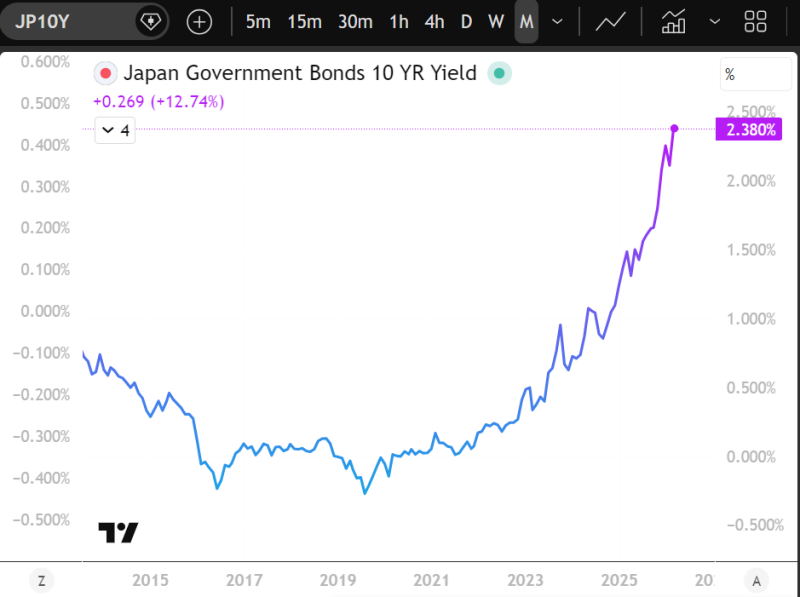
Japan’s 10 year yield has climbed to levels not seen since 1999. At first glance, that may look like just another milestone in the bond market, but it signals something much bigger. This is what happens when a market that has been held down for decades starts to move again.
Why yields were kept so low
Japan did not end up with low yields by accident. For years, Bank of Japan actively kept rates suppressed in an effort to fight deflation and support economic growth. Cheap money became the foundation of the system. Mortgages stayed low, companies were able to refinance endlessly, and the government could carry a massive debt burden without immediate pressure.
At one point, the Bank of Japan went even further by introducing yield curve control, effectively deciding where long term interest rates should trade. This meant that the bond market was no longer fully driven by supply and demand, but heavily shaped by policy.
What changed
That environment is now starting to shift. Inflation in Japan is no longer negligible, wages have been rising, and price pressures are proving more persistent than in previous cycles. This changes the central bank’s position.
The Bank of Japan has already stepped away from negative rates and gradually reduced its direct control over the bond market. As that support fades, the market begins to reassert itself. Investors start demanding compensation again, and yields begin to move more freely.
This is what “normal” looks like
Rising yields are not the core issue here. They are the outcome of a system transitioning back toward normal conditions. For a long time, Japan did not have a fully functioning bond market in the traditional sense. It had a managed one.
Now that intervention is being scaled back, capital is starting to be priced more realistically. Risk is no longer absorbed by policy to the same extent, and the cost of money is beginning to reflect actual market dynamics. The move toward 2.38 percent is a reflection of that shift.
The hidden risk: debt
This transition also brings a more uncomfortable reality into focus. Japan carries one of the highest levels of government debt in the world. As long as yields were near zero, that was manageable. As yields rise, the cost of servicing that debt increases.
Even relatively small increases in interest rates can have a significant impact over time. This means that what appears to be a market adjustment also has important implications for fiscal stability.
Why this matters globally
Japan’s bond market does not exist in isolation. For years, it functioned as a global anchor of low interest rates. With domestic yields near zero, Japanese investors were incentivized to allocate capital abroad in search of returns.
As yields in Japan rise, that dynamic begins to change. Domestic bonds become more attractive, capital flows can shift, and global liquidity conditions can tighten. Moves in Japanese yields therefore have the potential to ripple through other markets.
The bigger picture
Japan kept yields artificially low for decades because it was necessary in a deflationary environment. However, suppressing markets does not eliminate underlying risks, it only postpones them.
What we are seeing now is not simply a spike in yields, but a gradual adjustment as the system moves back toward price discovery. After years of intervention, the bond market is beginning to function more on its own again. That process is unlikely to be smooth, and its effects will extend far beyond Japan.

Add comment
Comments